Dark Social and the Missing Click: What Your Marketing Dashboard Cannot Tell You
Why invisible sharing complicates marketing measurement, and a better way to use GA4 and customer evidence.
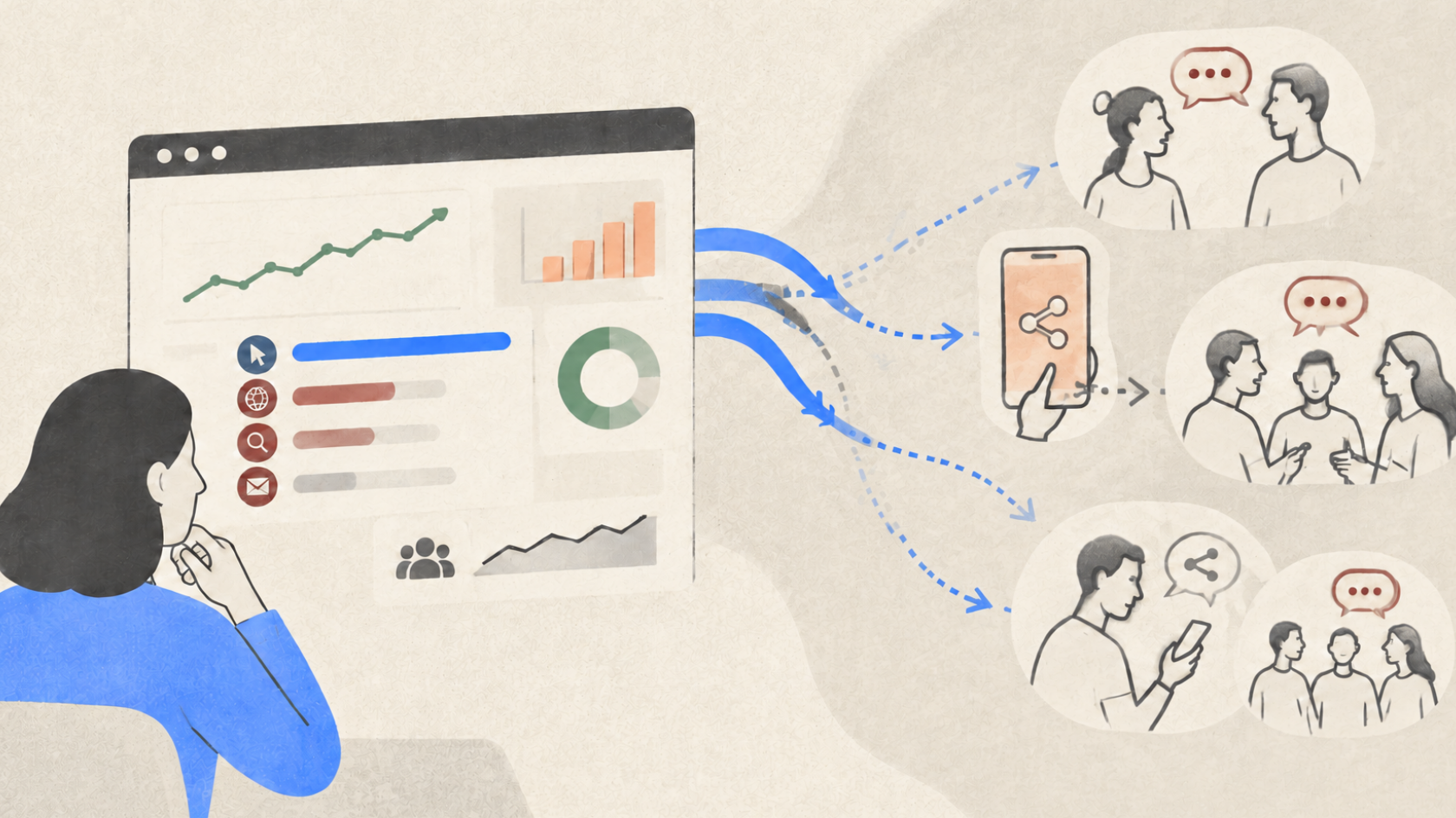
A customer reads your article, forwards it to a colleague on WhatsApp, receives a recommendation in a private group and finally types your website address into a browser. Your analytics report may record a direct visit and an enquiry. It probably cannot tell you about the conversation that made the visit happen.
This is the gap often described as dark social: recommendations and sharing that occur in channels where conventional website analytics cannot reliably see the original source. It does not make analytics pointless. It makes simplistic claims about what 'drove' a conversion much harder to defend.
Direct traffic does not necessarily mean someone typed your web address
Google's official GA4 guidance on '(direct) / (none)' traffic explains that this classification means Analytics lacks a clear referring source. It can include genuine direct visits, links from documents, missing campaign tags, tracking interruptions and other situations where referral information is unavailable. It cannot be treated as an accurate count of recommendations shared in private messages.
That distinction matters because a marketer who labels every direct visit as dark social is making one unsupported assumption to solve another. The better position is to acknowledge that some influences are observable, some are incomplete and some cannot be recovered after the fact.
Why buying journeys refuse to fit into neat channel boxes
A potential buyer might discover a brand through a podcast, compare alternatives using Google, see a LinkedIn post, ask a friend, revisit through an email and then enquire. Different tools may observe different slices of that process. A last-click report answers one question about the recorded final interaction; it does not necessarily identify the first influence or the decisive human recommendation.
In its guidance on attribution models, Google explains that credit for a key event can be distributed across observed touchpoints in different ways. GA4 provides path and model-comparison reports, subject to property settings and data availability. Those models are valuable for interrogating recorded activity. They are not a magical way to reconstruct private discussions that were never measured.
An illustrative example: the report tells one story, the customer tells another
Imagine a specialist manufacturer running LinkedIn thought-leadership posts and a webinar series. Enquiries appear to come mostly from direct traffic and branded search. During sales calls, several prospects say that industry peers sent them recordings of the webinars. It would be wrong to conclude from that small group that every direct enquiry came from the webinar, but it would also be wrong to ignore the feedback because the dashboard could not assign a click.
This hypothetical example shows why sales conversations and analytics belong in the same evaluation. One is imperfect qualitative evidence, the other is incomplete behavioural evidence. Together they may reveal a more useful pattern than either alone.
Five practical ways to make the picture clearer
First, use campaign tagging consistently. Add appropriate UTM parameters to links you control, such as newsletters, partner placements, paid campaigns and selected social posts. Agree on a naming convention before everyone on the team invents their own. Avoid adding new campaign parameters to links within your own site, which can distort reporting.
Second, ask an open-ended question. Include 'How did you first hear about us?' in enquiry forms or sales qualification, when appropriate. Allow more than one influence and keep a free-text option. Do not force people to choose a single platform if their answer is 'a colleague mentioned you, then I searched'.
Third, record a lead source and a buying influence separately. Your CRM can hold the technical channel that captured the form alongside the customer's own description of their journey. A self-reported answer is a useful clue, not independently verified attribution.
Fourth, compare patterns over time. Look at branded search, relevant direct visits, email enquiries, high-intent page activity and qualified opportunities alongside content and partnership activity. Seek repeatable relationships, not one dramatic coincidence.
Fifth, test important decisions carefully. Where scale allows, use incrementality experiments or holdouts rather than assuming that an attribution report proves causality. Smaller businesses can still run modest, clearly defined tests, while being honest about the uncertainty of small samples.
Measurement also has a privacy boundary
Tracking every person everywhere is neither possible nor desirable. In April 2026, the UK's Information Commissioner's Office published updated guidance on storage and access technologies, including cookies, pixels and device fingerprinting. Businesses should make tracking choices with the relevant privacy rules in mind, rather than looking for ways around user preferences. The exact requirements depend on the technology and applicable law.
Better marketing decisions do not require pretending to have a complete record of everyone's behaviour. They require being clear about what data represents, what it misses and which decisions it can reasonably inform.
Do not punish a channel simply because its influence is difficult to count
An honest newsletter, a useful industry article or a strong referral programme may influence a sale long before the final click. If a business only funds what is easiest to attribute, it risks overvaluing conversion-capture channels and underinvesting in the work that creates interest in the first place.
At Verve & Metric, we believe reporting should help a business make decisions, not provide false certainty. If the dashboard looks healthy but the commercial story is unclear, start with the questions in our guide to knowing whether your marketing is working. The most useful report is not the one with the most precise-looking numbers. It is the one that explains what you can conclude, what you cannot and what to investigate next.