The Trust Tax: Why Proof Beats Polish in Marketing
Brand trust is part of the buying decision. A practical look at proof, transparency and conversion.
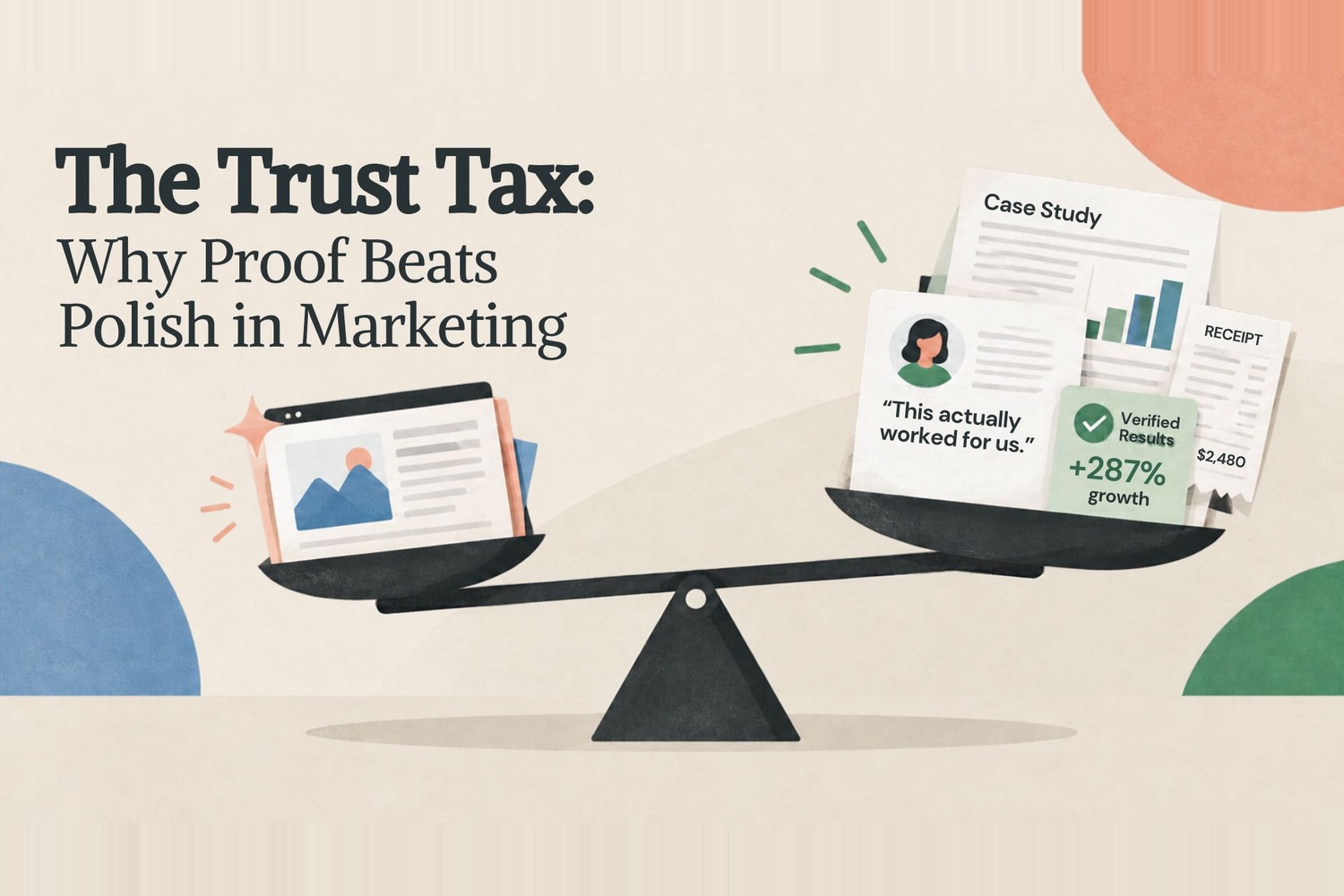
Imagine two businesses offering a similar service at roughly the same price. Both have polished websites. One tells you it is innovative, passionate and committed to excellence. The other explains precisely what happens after you enquire, shows how it works, identifies the people responsible and answers the awkward questions about cost and risk. Which feels easier to buy from?
That gap is what we call the trust tax: the commercial friction created when customers must work too hard to decide whether a promise is believable. It is our term for a practical problem, not an independently measured economic indicator. A brand can have beautiful design, expensive advertising and impressive traffic while still losing people at the point of doubt.
Trust is not a soft metric
In Edelman's 2026 Trust Barometer special report on brands, 88% of respondents said trusting a brand was an important or critical purchase criterion, comparable with quality (89%) and value (88%). The study surveyed 17,688 people across 15 countries in April and May 2026. These are self-reported attitudes across the countries surveyed, not proof that trust will lift every business's sales by a given percentage.
Still, the finding challenges a common marketing habit. We spend enormous effort getting people to notice us, then leave them to guess whether our claims are credible. Attention may start the conversation. Confidence helps someone move forward.
A polished promise is not the same as proof
Consider words such as 'trusted', 'award-winning', 'premium', 'expert' or 'customer-first'. They can be legitimate when supported. Without evidence, they are simply claims competing with thousands of near-identical claims. A better question is: what could a sceptical buyer check for themselves?
Useful proof might include transparent deliverables, clear qualifications, authentic customer reviews, evidence of previous work, independently verifiable credentials, realistic timelines and an explanation of what happens if something goes wrong. A newer business that cannot yet display an extensive portfolio can still demonstrate its working process, answer customer questions intelligently and be transparent about its experience. Do not invent testimonials or imply results that have not been achieved.
The buying journey exposes the trust gaps
Checkout research illustrates how practical barriers undermine confidence. The Baymard Institute's research on ecommerce checkout estimates an average cart abandonment rate of about 70%. Much of that is ordinary browsing, not failure. But Baymard's consumer research also identifies concerns about extra charges, required account creation and payment security among avoidable reasons some shoppers leave. The lesson goes beyond retail: uncertainty about terms, effort or risk can interrupt a decision even after interest exists.
For a consultancy, the equivalent could be a vague contact form followed by an unexpected sales call. For a software business, it might be hidden pricing or unclear cancellation terms. For an online shop, delivery conditions that surface only at checkout. These are different situations, but the underlying marketing problem is similar: the customer is being asked for commitment before receiving enough clarity.
Build a proof map, not another slogan
First, identify the buyer's doubts. Talk to prospects, review objections in sales conversations, and read the questions that recur in enquiries. Do people worry about price, quality, delivery, reliability, privacy or whether they are the right fit? Resist solving a problem you have invented.
Next, connect each doubt to evidence. If people worry that onboarding will be complicated, show a simple outline of the first two weeks. If they fear hidden costs, explain how charges work. If they want reassurance about outcomes, describe relevant work honestly, including limitations.
Then, place that evidence where the doubt occurs. A case study buried three pages away from the enquiry form may be less useful than a concise example next to the service description. Good marketing architecture makes reassurance easy to find rather than forcing visitors to hunt for it.
Relevance and trust need to work together
Edelman's same 2026 report argues that relevance is not merely cultural popularity; people also evaluate whether a brand is useful, aligned with their needs and credible in their context. Its findings suggest that brands earning both trust and relevance have greater latitude to expand into new audiences. That does not mean a business should imitate every cultural moment. It means knowing when its offer genuinely matters, and having the evidence to earn the right to be chosen.
Consider a hypothetical accountant specialising in independent cafés. Generic messaging about financial excellence could be replaced with a simple, grounded guide to cash-flow patterns in hospitality, a clear explanation of what monthly support includes and an example of the reporting a client receives. The result is not necessarily louder marketing. It is marketing that understands the customer's situation and reduces uncertainty.
Measure confidence as well as clicks
Track more than traffic. Watch qualified enquiry rates, how frequently people ask basic questions your site should answer, abandonment in important forms, the proportion of leads that reach a meaningful sales conversation and the reasons prospects do not proceed. Review customer comments for recurring confusion. The data will not isolate 'trust' as a perfect causal variable, but it can reveal where confidence is breaking down.
At Verve & Metric, the order matters: understand the customer, sharpen the offer, make the proof visible, then amplify it. Our guide to strong marketing foundations expands on that approach. If your brand looks good but still feels difficult to choose, another design refresh might not be the first thing it needs.